

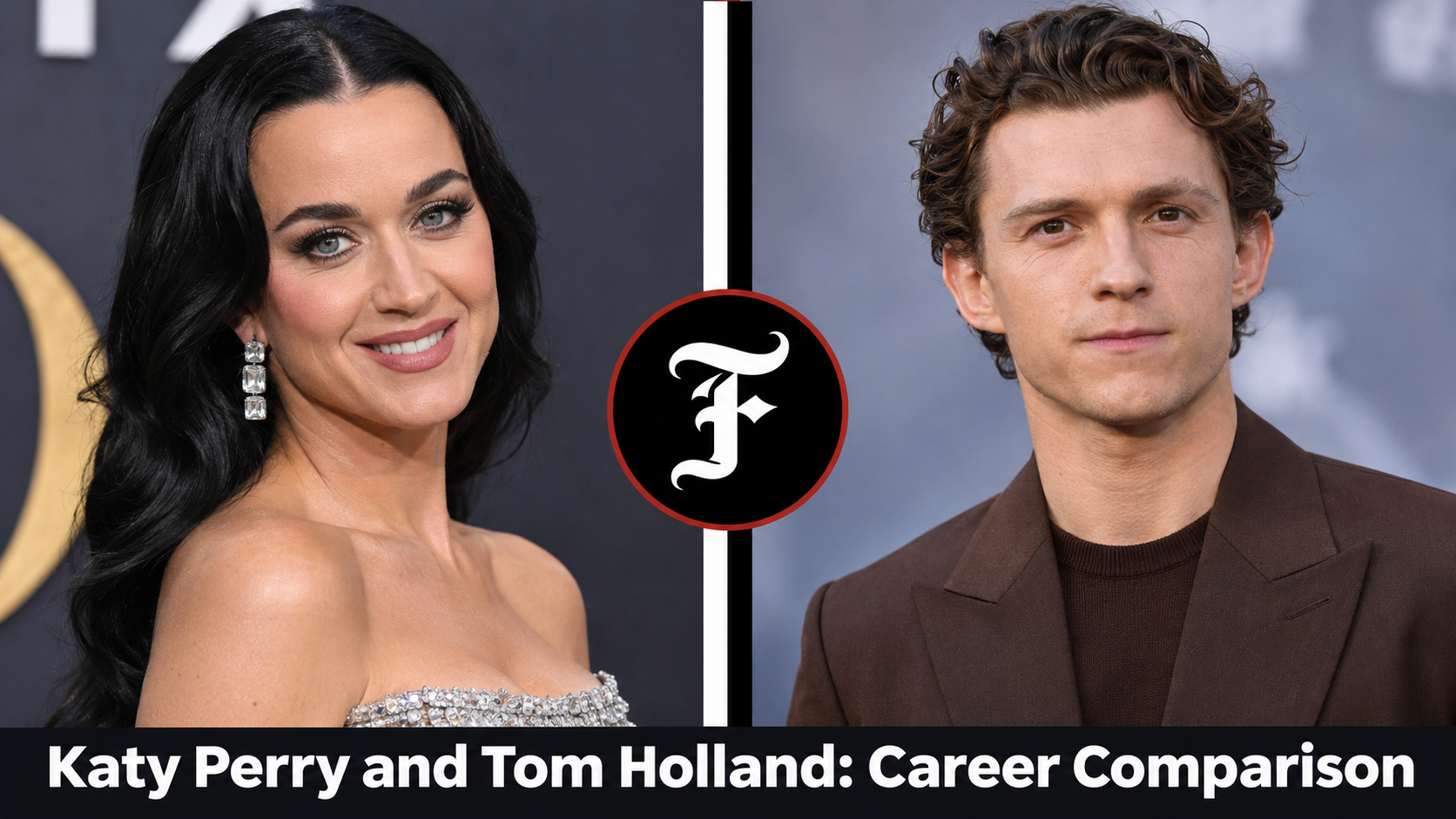
Katy Perry and Tom Holland are entertainment figures whose careers operate primarily through different media: pop music and screen acting. Comparing them is most useful when it explains their work, public-facing projects and the different evidence needed to assess success in each field.
This article is a career comparison, not a claim that the two share a personal relationship. A combined search keyword does not establish a romance, collaboration or private connection. The discussion stays with identifiable professional work and clearly labelled analysis.
Official music pages and studio film records provide a stronger starting point than speculative celebrity summaries. They establish releases, roles and announcements, while leaving room for independent judgement about artistic value. They do not disclose a complete personal financial position or every detail of a performer’s private life.
Katy Perry and Tom Holland Work in Different Formats
Perry’s public work includes recorded music and live performance. Holland’s film work involves playing characters within productions made by larger creative teams. Both careers depend on collaboration, but the audience encounters the results in different ways.
A song may be heard repeatedly outside the context of an album or concert. A film performance is ordinarily encountered through a longer story whose writing, direction and editing shape the character. Neither format is inherently more demanding or valuable; they simply invite different questions about craft and reach.
For a fair comparison, state what you are comparing. Public recognition, artistic choices, commercial performance and personal wealth are separate subjects. A large number attached to one of them should not silently become evidence for all the others.
Perry’s Music Catalogue Provides the Starting Point
The official Katy Perry music catalogue identifies releases available through her own store, including Teenage Dream. The official 143 album listing identifies 143 as her sixth studio album. Those pages are useful for release identification, though their promotional descriptions should not be mistaken for independent criticism.
The RIAA’s historical account of its certification programme records Perry becoming the first artist to receive three Diamond Song Awards, identifying Roar, Dark Horse and Firework. This is a specific milestone within the US certification system, not a current count of every award she has received or a measurement of worldwide listening. Keeping the scope attached makes the achievement clearer rather than less impressive.
A listener can approach the catalogue through albums rather than only the most familiar single. Compare how a collection introduces its sound, varies its pace and returns to particular ideas. Those are listening questions, not a claim that every release follows one fixed artistic formula.
Do not infer current tour dates from an old album announcement. Live schedules are separate, changeable information. Check the artist’s current official event information before making travel or ticket decisions. A historic performance clip demonstrates that an event occurred, not that another event is scheduled in the same place.
Holland’s Film Roles Are Best Checked Through Credits
Studio records identify Holland’s role as Peter Parker in Spider-Man: Homecoming. The official Sony Pictures film page provides the cast and story context. Use those credits to distinguish the actor from the fictional character and from other adaptations of Spider-Man.
The official Uncharted page identifies Holland as Nathan Drake. That gives a second clear example of his work in a different screen property. It does not establish that the character’s experiences or personality describe the actor himself.
Sony’s December 2024 Billy17 announcement also documents Holland moving into a producing partnership with Harry Holland and Will South. The announcement describes a slate, including the project Burnt, rather than proving that every named production has since been released. It is a useful example of a career extending beyond the role visible on screen, while still requiring dated language about development plans.
A viewer comparing roles can ask how a performance changes with the surrounding story. Is the character learning, concealing information or trying to prove something to another person? Those questions help explain acting choices without inventing a private account of the actor’s intentions.
Compare Persona With Character Carefully
A pop performer may present a recognisable public image across music, visuals and stage appearances. A screen actor plays characters who can be distinct from that actor’s public identity. Both involve performance, but neither gives an audience unrestricted access to the person’s private self.
When discussing Perry, distinguish the speaker or scenario within a song from a verified autobiographical statement. When discussing Holland, distinguish a fictional character’s behaviour from the performer’s beliefs. This avoids a common celebrity-writing error: treating every creative work as a direct personal confession.
You can still analyse how public presentation shapes an audience’s expectations. Explain the image or role you are responding to and identify the work where it appears. Keep the conclusion at that level unless a reliable interview or official statement supports a broader claim.
Our Tyra Banks and Greg Hayes comparison similarly shows why public names need to be connected to the actual professions under discussion. A useful comparison begins by identifying the work rather than assuming fame makes every career measure equivalent.
Do Not Compare Incompatible Success Measures
A streaming count, an album sale, a ticket sale and a film’s box-office revenue measure different activities. They cannot be converted into a simple ranking of talent or public affection. Even within one medium, a number needs a date, market and definition to be meaningful.
A film’s gross revenue also belongs to the production’s commercial performance, not automatically to one cast member. A music purchase does not reveal the artist’s personal take-home income. Contracts, costs and rights arrangements affect the relationship between public sales figures and individual earnings.
For this reason, no precise net-worth comparison is offered here. Repeating an unsourced estimate would create a false appearance of financial knowledge. A reader interested in commercial context should begin with a clearly identified metric and its original source, then explain what that metric cannot establish.
Use Releases to Build a Better Introduction
For someone new to Perry, choose a small listening sample and explain why it represents the aspect of her work you want to explore. That might be an album’s overall construction or the relationship between a recording and a live presentation. Do not claim that a short sample captures an entire career.
For Holland, select a film and pay attention to the character’s changing objectives. A performance can look different when viewed within the complete story rather than through a compilation of isolated moments. Avoid making a career-wide judgement from a short promotional clip.
If you compare the two in a discussion group, give each medium its own vocabulary. Ask about melody, arrangement and vocal presentation for a recording; ask about character, scene interaction and dramatic progression for a film. Shared questions about collaboration and audience response can follow once the distinct work is understood.
Separate Confirmed Work From Future Speculation
Entertainment coverage often moves quickly from an announcement to assumptions about a finished project. A casting announcement, a production plan and a released work are different milestones. Identify which stage the source establishes before writing as though an audience can already see the result.
Similarly, do not assume a collaboration because two names circulate together on social media. Look for an actual official announcement, release credit or reliable account of the event. An image montage or fan-created post can be interesting without proving that its subjects worked together.
Our Millie Bobby Brown and Safra Catz article provides another cross-profession comparison where the central question must be explicit. Readers deserve to know whether a piece examines careers, documented connections or a specific project.
Keep the Comparison Useful to Readers
A strong comparison leaves the reader with a clearer way to explore both bodies of work. It might explain which official pages identify releases, what questions to ask while watching or listening and why financial headlines need caution. It should not manufacture a dramatic connection to justify placing the names together.
For Perry and Holland, the useful connection is the broader work of entertainment performance: creating an audience-facing result through a team, a medium and a public presentation. Their careers can illuminate that subject without becoming interchangeable. Respecting the differences makes the comparison more informative than declaring an unsupported winner.
Frequently Asked Questions
Are Katy Perry and Tom Holland in the same profession?
Their principal public work is in different media: Perry in music and Holland in screen acting. Both participate in collaborative entertainment production.
Does this comparison establish a romantic relationship?
No. It makes no such claim. A shared search query is not evidence of a personal relationship.
Which Tom Holland roles are identified here?
Peter Parker in Spider-Man: Homecoming and Nathan Drake in Uncharted, as identified by the cited Sony Pictures pages.
What is 143 in Perry’s catalogue?
Her official album listing describes 143 as her sixth studio album. Use the actual release page for edition-specific information.
Can sales or box office establish personal net worth?
No. They do not provide a complete account of individual income, assets, liabilities or contractual interests. No verified wealth ranking is asserted here.
