

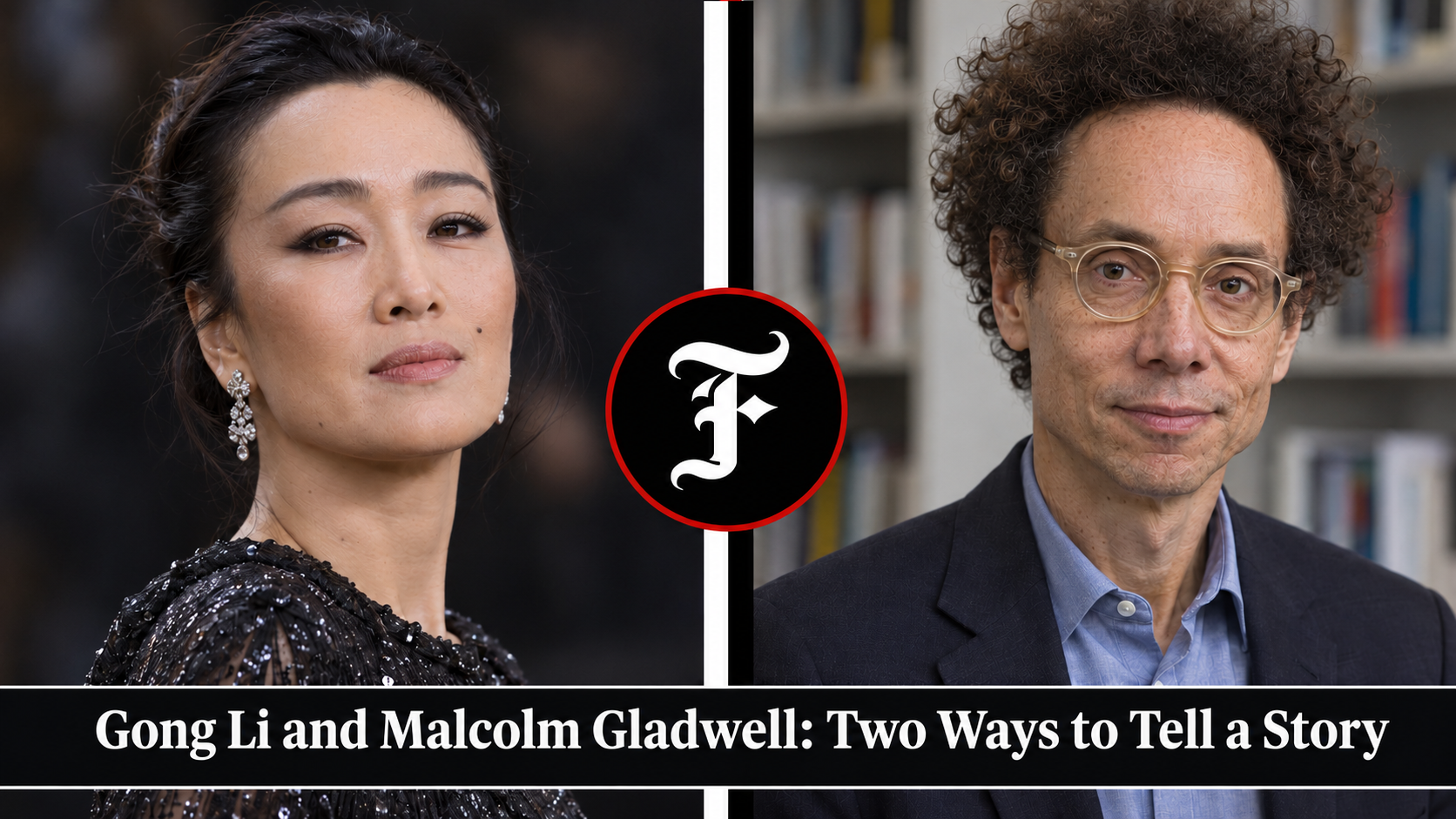
Gong Li and Malcolm Gladwell are prominent storytellers in different media: Gong Li through screen performance, Gladwell through nonfiction writing and audio. The sources reviewed here establish separate professional careers, not a joint project or a personal relationship. Their names can be compared meaningfully without inventing a connection between them.
The useful angle is how each medium guides an audience. An actor helps give a character presence within a film. A nonfiction writer selects evidence, examples and explanations to develop an argument. Those activities can both shape understanding, but they have different standards and different relationships with factual claims.
Gong Li’s Career Begins with Performance
The Golden Globes profile of Gong Li provides a professional overview of her screen career. Her association with films such as Red Sorghum is part of the established background. A filmography helps identify the work, but it does not tell viewers everything about how a performance was developed or how creative decisions were divided among collaborators.
Acting takes place within a wider production. Direction, writing, editing, sound and other contributions help determine what appears on screen. Describing an actor’s contribution should therefore avoid implying that one performer independently controlled every aspect of a film. The finished work is the result of several connected creative roles.
For a viewer, a useful starting point is the actual performance rather than a collection of promotional labels. Notice the scenes, relationships and changes within the character. This produces a more specific discussion than simply repeating that an actor is important or internationally recognised.
Gladwell Works Through Nonfiction and Audio
Penguin’s Malcolm Gladwell author page identifies books including The Tipping Point, Blink and Outliers, as well as his work in audio. His official speaking page provides another direct route to his public professional activity. These sources establish the identity of the writer rather than a link to Gong Li.
A nonfiction argument asks readers to consider how examples and evidence support an explanation. The interest of the story is only one part of that process. A reader should also examine what the evidence can establish, which alternatives are considered and whether the conclusion goes further than the examples support.
Audio introduces a voice and a sequence of listening, but it does not remove the need to check a factual claim. A compelling delivery can make an explanation memorable. It should not be mistaken for independent proof that every inference is correct.
Performance and Explanation Ask Different Things of the Audience
A fictional character can be convincing without being a factual account of a real person. A nonfiction example, by contrast, may be offered as evidence for a claim about the world. Confusing those expectations can lead readers to judge both media by the wrong standard.
In a film discussion, interpretation often concerns how a scene works and what it suggests. Several readings may be reasonable. In nonfiction, an interpretation can also be debated, but the factual material supporting it needs verification. The reader must distinguish an established observation from the explanation built around it.
This difference does not make one medium more valuable than the other. It makes the questions more precise. Ask what the work is trying to do, what type of claim it makes and how its medium supports that purpose. A strong comparison begins there rather than forcing an actor and writer into a single popularity contest.
A Practical Way to Compare Their Work
Choose one film performance and one nonfiction work, then define a manageable question. You might examine how the audience is introduced to uncertainty, how attention is directed or when an important piece of information becomes available. Keep the comparison attached to the works rather than making claims about private intentions.
For the film, note the scene and the observable choices that shape your reading. For the nonfiction work, identify the proposition and the evidence used to support it. A comparison becomes clearer when it states what can actually be examined rather than relying on an impression that both people are “good storytellers.”
Avoid assuming that similar effects prove shared influences. Two works can use surprise or a change of perspective without their creators having collaborated or copied one another. A claim of influence needs its own source, such as a direct statement or documented professional connection.
Why the Paired Search Does Not Prove a Relationship
Search phrases are not biographical evidence. A page can place two names together for comparison, and that pairing can then appear in further search results. Repetition of the pairing does not establish that the people met, worked together or have a personal connection.
The sources used for this article describe their separate careers. They do not supply a documented joint project. The accurate response is to state that limit, then offer a comparison grounded in the public work. It would be misleading to fill the gap with a fabricated interview, event or friendship.
The same principle applies to photographs. A side-by-side editorial portrait is a design choice, not evidence that two people attended the same event. Readers should look for a caption and source before treating an image composite as a record of an encounter.
Fame, Influence and Wealth Are Different Questions
A career can be influential without a public personal balance sheet. Book sales, film revenue and audience recognition measure different things, and none automatically equals the creator’s net worth. This article does not invent a financial ranking from the two careers.
If a reader wants to compare influence, the criteria should be explicit. Awards, professional recognition, circulation and the responses of particular audiences can each contribute evidence, but they are not interchangeable. A single number rarely captures the full professional significance of an actor or writer.
The Flicker Magazine’s Audrey Hepburn and Bill Gates feature offers another cross-field comparison. Its Jennifer Lawrence and Jim Taiclet article likewise separates careers rather than assuming a joint enterprise. Those examples show why a useful paired profile needs a clear angle.
A Comparison Can Be Specific Without Claiming Influence
For example, a viewer might discuss how a film delays information about a character, while a reader examines when a nonfiction chapter introduces a piece of evidence. The parallel concerns the audience’s experience of sequence. It does not prove that the actor and author share a method, intention or influence.
Write the comparison as an observation about the selected works. Identify what is being compared and where the analogy stops. A performance depends on collaboration within the film, while a nonfiction claim also depends on the quality of its factual support. Those limits are part of the comparison rather than an obstacle to it.
This approach gives readers a practical way to engage with both careers. Instead of collecting unrelated biographical facts, they can examine a clear question about storytelling while retaining the distinction between interpretation, documented professional history and a claim that would need additional evidence.
Frequently Asked Questions
Have Gong Li and Malcolm Gladwell worked together? The sources reviewed for this article do not establish a joint project. The article compares their separate public careers.
What is Gong Li known for? She is an internationally recognised screen actress. The linked professional profile provides an overview of her work and career context.
What is Malcolm Gladwell known for? He is a nonfiction writer and audio creator associated with books including The Tipping Point, Blink and Outliers. Check current official and publisher pages for his work.
Why compare an actor with a writer? Their media offer different ways to guide an audience. The comparison is useful when its criteria are explicit and grounded in the actual works.
Does the cover show a shared event? No. It is an editorial portrait composite and should not be read as evidence of a meeting or collaboration.
