

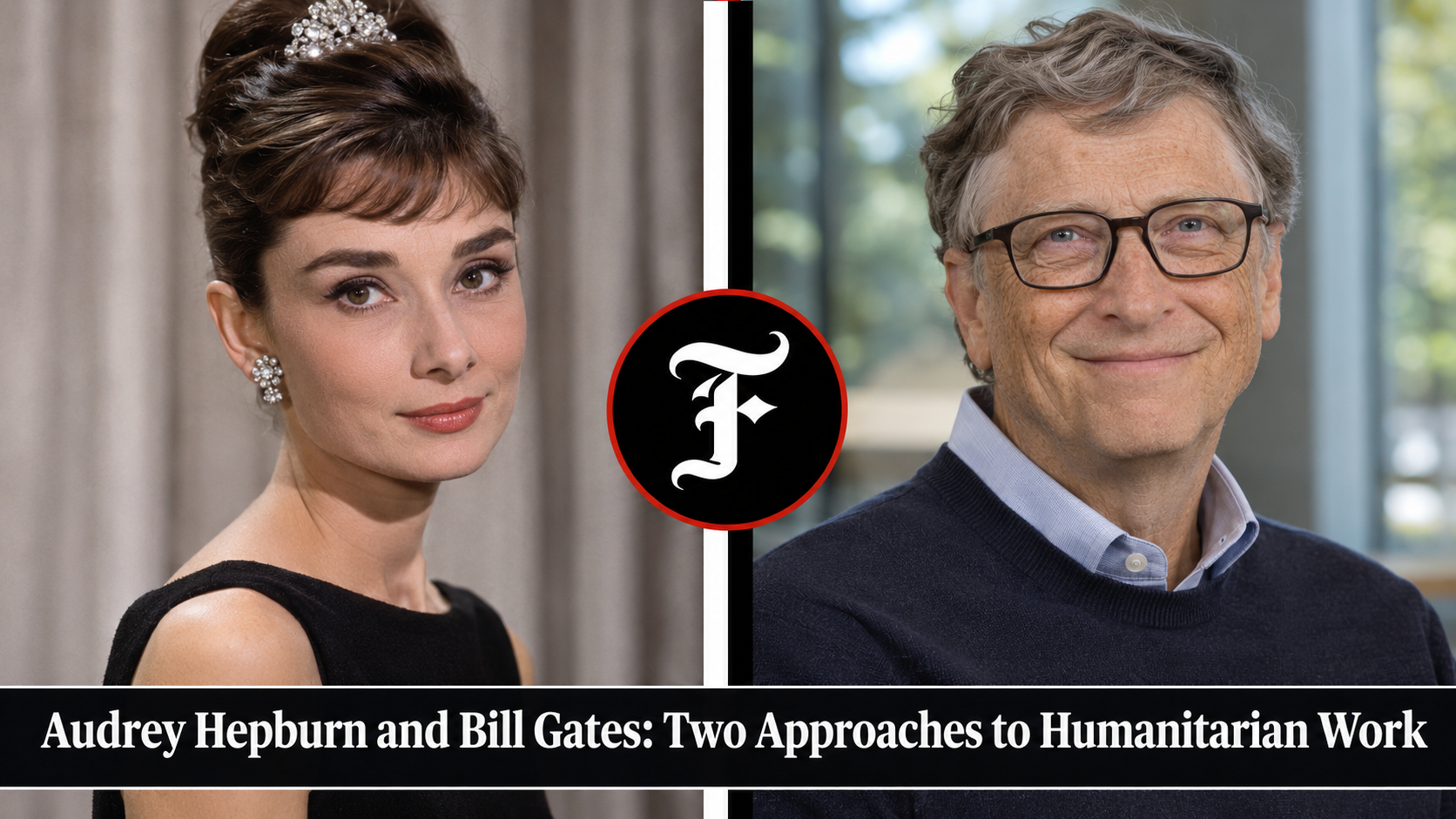
Audrey Hepburn and Bill Gates are associated with different forms of humanitarian work: Hepburn through advocacy as a UNICEF Goodwill Ambassador, and Gates through institutional philanthropy. Their comparison is useful for understanding how public attention and financial resources can support a cause in different ways. It does not establish that they operated a joint charitable project.
The timeline matters. Hepburn’s UNICEF work belongs to the final years of her life, while the Gates Foundation’s present organisation and activities belong to a different period. A responsible comparison keeps those histories separate and examines the institutions involved rather than inventing a shared campaign to explain the paired names.
Audrey Hepburn and Bill Gates: the verified roles
UNICEF identifies Hepburn as a Goodwill Ambassador from 1988 to 1993. Its account describes field visits, public advocacy and work drawing attention to children’s needs. This provides direct evidence of a defined institutional role rather than a vague statement that she cared about charity.
The Gates Foundation’s fact sheet identifies Bill Gates as its chair and describes his role in setting direction and approving strategies. A foundation leadership position differs from an ambassadorial appointment. Both can support humanitarian activity, but the authority and responsibilities are not interchangeable.
Hepburn’s public recognition became a channel for advocacy
A well-known performer can attract attention from people who might otherwise overlook an issue. An ambassador’s work can include visiting programmes, speaking publicly and helping explain an organisation’s priorities. The role is most useful when it directs audiences toward the people and services involved rather than making the public figure the entire story.
UNICEF’s account of Hepburn’s work describes visits to several kinds of programmes and her communication with media and public institutions. The important point is the connection between witnessing the work and helping explain it. Her celebrity made access to an audience possible; the organisation’s programmes and the communities it served remained the substance of the advocacy.
This distinction also helps avoid overstating individual causation. A public appearance may raise awareness, but a claim that it produced a specific financial or health outcome needs evidence. The work of local staff, partner organisations and communities should not disappear behind a famous name. Recognition can support a programme without becoming its sole explanation.
Foundation work involves allocating resources
A grant-making institution has to decide what to support, how to structure the support and how to assess progress. The public reputation of a donor can attract interest, but the operating question concerns programmes, partners and results. Money needs a purpose and an implementation route before it can produce the intended benefit.
The foundation’s own documents are useful for understanding its stated priorities and leadership. They should be read as the institution’s account, not as independent proof that every strategy has achieved its aims. Evaluation requires attention to the specific programme, the evidence collected and the limits of what can be attributed to the funding.
It is also important to distinguish an individual’s personal assets from assets held within a charitable institution. A foundation has its own governance and obligations. Its budget should not casually be counted as the donor’s spendable personal money. The legal and organisational structure matters to any financial discussion.
Advocacy and funding can complement one another
Attention can help a problem become visible, while resources can support work intended to address it. Neither is automatically sufficient on its own. A widely discussed issue may still lack an effective programme, and a well-funded programme may still need public understanding and local trust. The relevant question is how the different contributions work together in practice.
This is an analytical comparison, not a claim that Hepburn and Gates coordinated these functions personally. Their documented roles belong to different institutions and periods. The comparison helps explain the distinction between mobilising attention and allocating resources without turning either person into a universal model of humanitarian action.
It also shows why the people receiving or delivering support should remain visible. Humanitarian work is not simply something done by famous people to passive recipients. Local knowledge, practical constraints and the agency of communities affect what is useful. A profile that ignores those elements can become a celebration of personality rather than an explanation of the work.
How to judge impact without relying on fame
Begin by identifying the intended outcome. Awareness, fundraising, access to a service and a measurable change in wellbeing are different results. A programme may achieve one without establishing all the others. Clear definitions help prevent a publicity measure from being presented as a complete humanitarian outcome.
Next, examine the evidence and time frame. A short-term activity report may show what was delivered, while a longer evaluation asks what changed and whether it lasted. Both can be useful, but they answer different questions. The strongest account explains the connection between the activity and the claimed result.
Finally, ask what other factors contributed. A programme can involve several funders, public authorities and local organisations. Attributing the entire outcome to one donor or ambassador can overstate the evidence. Acknowledging shared contribution makes the explanation more credible and more useful to readers trying to understand how humanitarian work actually happens.
Avoid a contest over who was more generous
Generosity is difficult to compare across time, roles and resources. An ambassador’s time and public advocacy are not measured in the same units as a grant commitment. Even financial figures need dates, definitions and a distinction between pledges and completed transfers. A simple ranking can obscure more than it explains.
This article therefore does not assign a personal moral score or a precise wealth comparison. It examines documented roles and the different mechanisms through which those roles can contribute. Readers can appreciate the significance of each without assuming that one number captures the whole value of a career.
Read historical and current profiles differently
A historical profile should preserve the dates and institutions relevant to the person’s lifetime. A current foundation page describes an organisation that can change over time. Combining the two requires care. Do not describe a late public figure as participating in a present campaign unless the wording clearly concerns a legacy or an institution acting later.
TheFlickerMagazine’s comparisons of Meryl Streep and Jet Li and Jake Gyllenhaal and Evan Spiegel provide related examples of keeping distinct careers separate. A paired headline can introduce analysis without proving an undocumented personal connection.
Keep institutional names and dates intact
Charitable institutions can change their public names, leadership and programmes. A source should be described according to the period it covers. This prevents a current organisational label from being projected backwards as if nothing changed, while allowing readers to recognise the continuity of the work.
For historical advocacy, the same care applies to photographs and quotations. Identify when and where they were recorded, and do not use a later caption to invent a new event. A familiar image can remain powerful without being presented as current. Preserving the original context helps the reader understand both the person and the institution accurately, rather than replacing history with a simplified modern narrative.
Accurate attribution supports that understanding.
Frequently asked questions
Did Audrey Hepburn and Bill Gates run a joint charity?
The sources reviewed here do not establish a jointly operated charitable project. Their documented roles are discussed separately.
When was Hepburn a UNICEF Goodwill Ambassador?
UNICEF records her ambassadorial service from 1988 to 1993.
What role does Gates hold in the foundation?
The foundation’s fact sheet identifies him as chair, with responsibilities involving strategy and institutional direction.
Does publicity prove humanitarian impact?
No. It can show attention, while claims about outcomes require evidence about the programme and the change being measured.
Why avoid a generosity ranking?
Advocacy, time and financial commitments are different contributions. Their value cannot be reduced responsibly to one unsupported scoreboard.

1 Comment
Pingback: Gong Li and Malcolm Gladwell: Two Ways to Tell a Story