

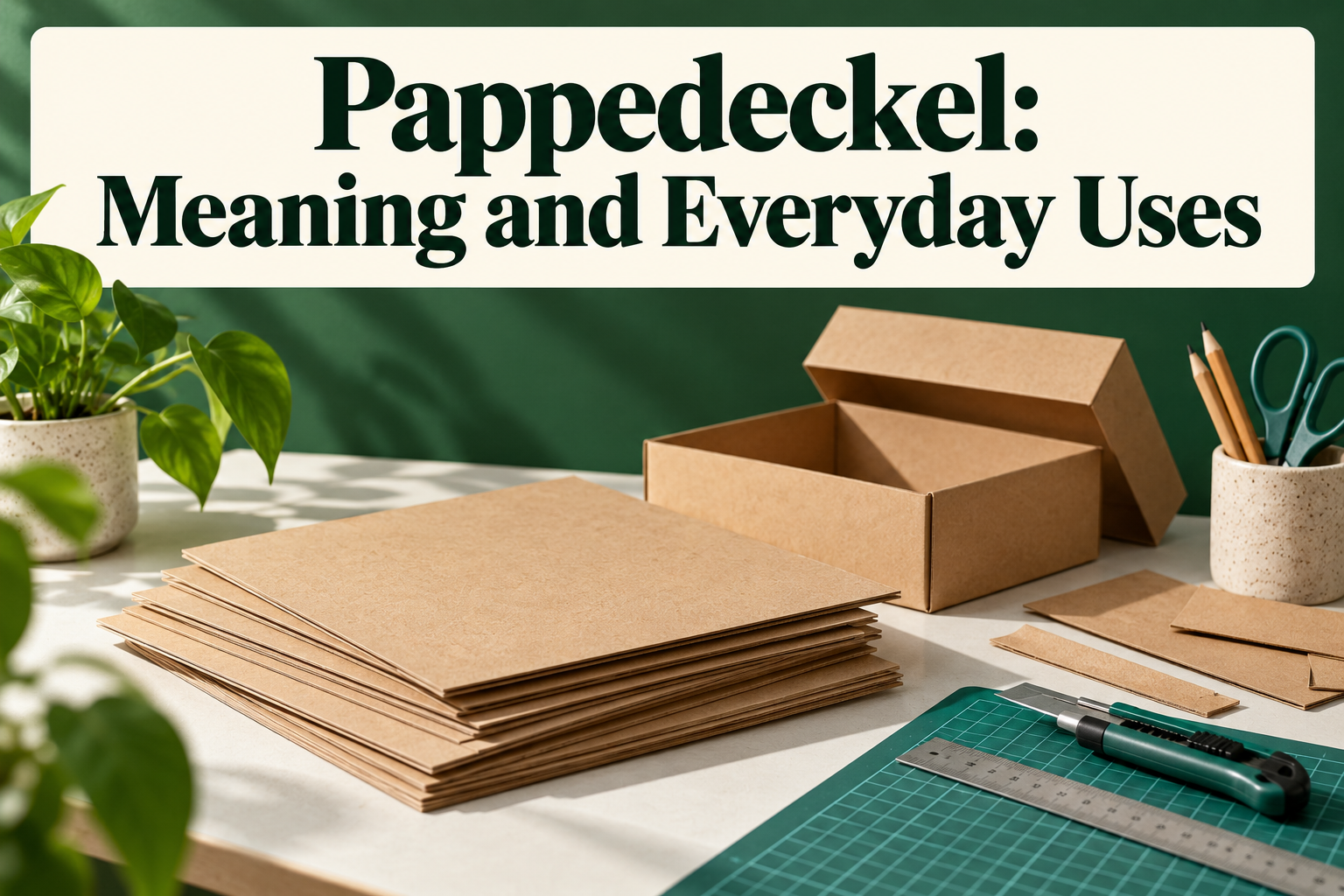
Pappedeckel is a search spelling associated with German words for a piece of cardboard or stiff paperboard. For standard dictionary usage, the verified forms are Pappdeckel and Pappendeckel.
That distinction matters when translating a description, buying craft materials or checking a claim online. The word alone does not establish a particular product, coating, food-safety certification or environmental benefit.
What Does Pappedeckel Mean?
Duden’s Pappendeckel entry defines the standard word as a piece of cardboard and links the related form Pappdeckel. The Pappdeckel entry likewise describes cardboard and gives an example involving serving a drink on it.
The exact search spelling Pappedeckel is not the headword of either of those entries. It is therefore better to explain the spelling difference than to present it as a separate internationally recognized material.
In an English translation, “cardboard,” “paperboard” or “a piece of card” may fit, depending on the object and context. If the item is a coaster or a box component, name that object as well so the reader knows what is being described.
Choose the Material by the Job
For a craft backing, start with the size, stiffness and surface you need. For protective packaging, consider the object’s weight, shape and the amount of movement inside the box. A word in a product title is less useful than a clear material specification.
Ask for thickness and dimensions rather than relying on a photograph. Two sheets that look similar online may behave differently when folded, cut or glued. If appearance matters, request a sample before buying a large quantity.
For a presentation board, a clean flat surface may matter most. For a model or prototype, repeated cutting and fitting may matter more. Defining the purpose first helps prevent buying an attractive material that is unsuitable for the actual task.
Cardboard Is Not a Complete Product Specification
A claim that an item is cardboard does not establish its strength, composition or suitability for direct contact with food. Coatings, adhesives and the intended use need separate consideration. Obtain the supplier’s documentation when a use has specific requirements.
Do not assume that all brown packaging is recycled or that all white board is unrecyclable. Colour is not a substitute for a composition statement. The same caution applies to broad terms such as “eco-friendly,” which need an explanation of the particular benefit being claimed.
For everyday purchasing, keep a short written specification: finished size, minimum stiffness, surface finish and intended use. This is more precise than asking a seller for the “best Pappedeckel.”
Practical Ideas for Reuse
A clean sheet can be useful as a temporary layout template, a divider in a storage box or a backing for a paper project. Treat these as possible projects rather than proof that every board grade will perform equally well.
Make a small test piece before committing to a finished project. Check how the board responds to your chosen adhesive, whether a folded edge stays neat and whether it remains flat after drying. A quick test is often cheaper than replacing a complete assembly.
If a piece has absorbed moisture or contamination, reassess whether it is suitable for reuse. Keeping a craft project dry and clean is a different question from claiming that the material meets a regulated safety standard.
Recycling Depends on the Finished Item
Recycle Now’s cardboard guidance lists many ordinary boxes and cardboard envelopes as recyclable, while identifying contamination such as food, dirt or paint as a problem. It also advises removing separate plastic or polystyrene components from corrugated packaging.
Check the collection rules for your own area. A mixed-material item may need different handling from a plain sheet, and a recycling claim on a shop page may refer to a different country’s system.
When in doubt, identify the whole item: cardboard box, coated carton, craft board or food-soiled packaging. That gives a local recycling service a more useful description than the search keyword alone.
Reading Unfamiliar Terms With Context
A clear definition should connect an unfamiliar word to an identifiable object. An article that turns a simple material term into a supposedly revolutionary technology should provide evidence for that larger claim.
Our CDiPhone music-workflow guide follows a similar approach to another ambiguous search term: establish the context and distinguish it from unsupported product claims. For a different example of handling an ambiguous online label, see our Duaction explainer.
Frequently Asked Questions
Is Pappedeckel the standard German dictionary spelling?
The verified Duden headwords are Pappdeckel and Pappendeckel. Explain the search spelling in context rather than treating it as a separate material standard.
Does it mean a cardboard lid?
A particular object could be a lid, but the verified dictionary entries refer more broadly to a piece of cardboard.
Is it always recyclable?
No universal claim is appropriate. Coatings, contamination and local collection rules affect the answer.
Can I use any cardboard for food packaging?
Do not assume so. Check documentation for the specific product and intended food-contact use.
What should I ask a supplier?
Ask for dimensions, thickness, stiffness, finish and suitability for your intended application.

2 Comments
Pingback: CDiPhone: CDs and iPhone Explained
Pingback: Nahttypen: A Guide to Seam Types